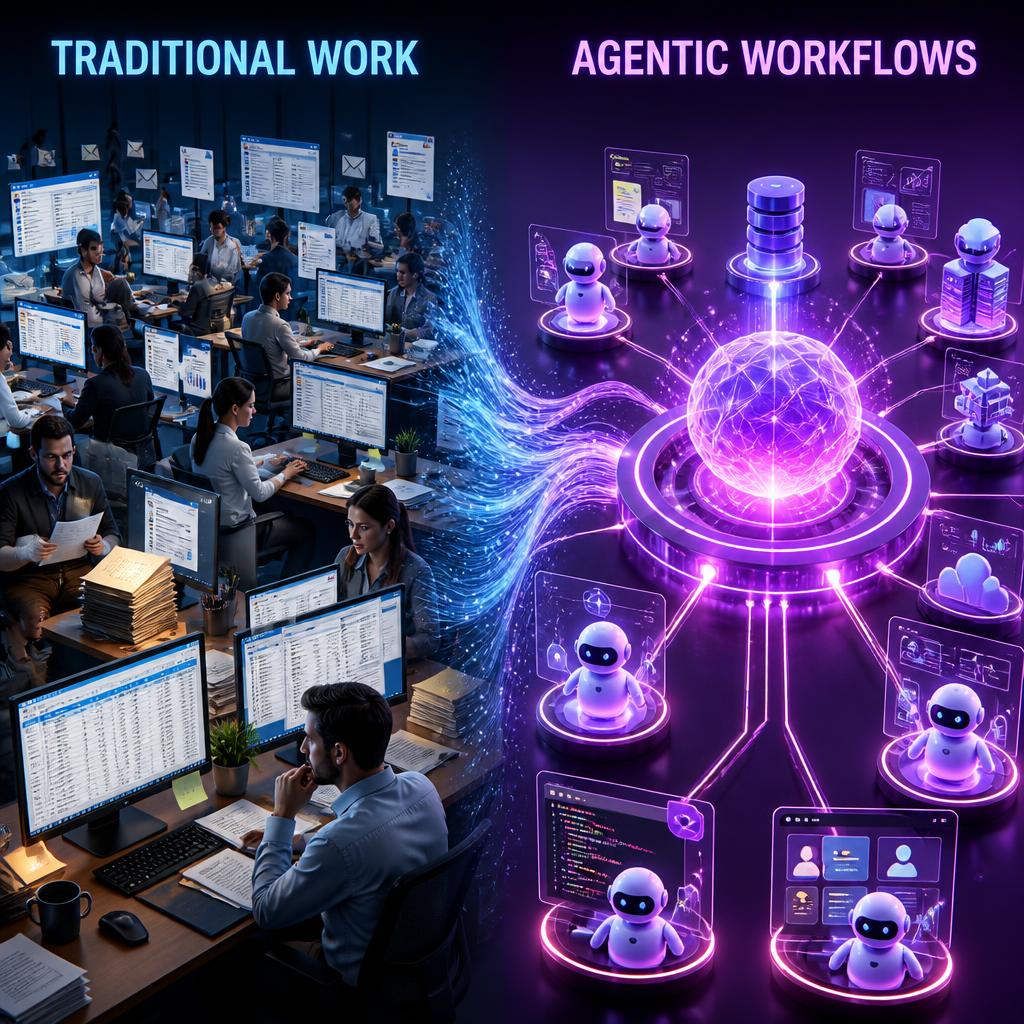
Concept illustration showing AI agents coordinating tasks, applications, and digital workflows across a modern workplace
Artificial intelligence is moving beyond generating content and answering questions. In 2026, AI agents are becoming increasingly capable of planning tasks, using tools, coordinating workflows, and operating with greater autonomy.
This shift is changing how organizations think about software and workplace productivity.
Instead of simply assisting employees, agentic AI can perform multi-step tasks and coordinate actions across different systems.
For businesses, this creates new opportunities to automate work while allowing employees to focus on higher-value activities.
Let’s break down the biggest developments shaping this transformation.
From AI Assistants to AI Agents
Early generative AI systems primarily responded to user prompts.
Agentic AI takes a different approach.
In these systems:
- Users provide goals rather than individual instructions
- AI agents plan multiple steps
- External tools can be used to complete tasks
- Workflows can adapt based on results
For example:
A traditional AI assistant might draft a sales email.
An AI agent could:
- Research the prospect
- Analyze previous interactions
- Draft a personalized email
- Update the CRM
- Schedule a follow-up
The system moves from generating content to executing workflows.
Multi-Agent Collaboration
One of the major developments in agentic AI is the ability for multiple specialized agents to work together.
Instead of relying on one general-purpose agent, organizations can create systems where agents have specific responsibilities.
Examples include:
- Research agents
- Coding agents
- Sales agents
- Customer support agents
- Data analysis agents
These agents can communicate with each other and divide complex tasks into smaller responsibilities.
This creates an architecture that resembles a digital team.
Better Tool and API Integration
AI agents are becoming increasingly capable of interacting with external tools.
They can connect with:
- Business APIs
- Databases
- CRM systems
- Project management platforms
- Internal applications
This allows agents to move beyond conversation and perform real actions.
For example, an agent receiving a customer request could retrieve account information, update a CRM record, create a support ticket, and notify the appropriate team.
APIs become the foundation that allows AI agents to interact with the business environment.
More Reliable Planning and Reasoning
Agentic systems are also improving their ability to break complex objectives into smaller steps.
Instead of responding immediately, an agent can:
- Analyze the objective
- Create a plan
- Execute individual tasks
- Evaluate results
- Adjust the workflow
This enables AI to handle longer and more complicated processes.
However, planning does not guarantee correctness.
Organizations still need evaluation systems and safeguards to prevent incorrect actions.
AI Agents in Software Development
Software development is becoming one of the most significant areas for agentic AI adoption.
AI coding agents can assist with:
- Writing code
- Debugging applications
- Generating tests
- Reviewing changes
- Updating documentation
More advanced workflows allow agents to work across repositories and development tools.
Developers increasingly act as reviewers and architects while AI handles portions of implementation.
This changes the role of developers from writing every line of code toward directing and validating AI-generated work.
Autonomous Business Workflows
Agentic AI is also moving deeper into business operations.
Organizations can use agents for:
- Customer support
- Sales operations
- Financial processes
- Employee onboarding
- Research and analysis
A single business process may involve several systems and multiple decisions.
Agents can coordinate these steps automatically.
This enables small teams to manage workflows that previously required significantly more operational resources.
Improved Memory and Context
Another important development is better handling of context.
Modern agents can use:
- Conversation history
- User preferences
- Business data
- Previous workflow results
This allows systems to maintain continuity across longer tasks.
For example, an employee could ask an agent to prepare a report based on previous project discussions, internal documents, and current data.
The agent can combine these sources instead of treating every interaction as an isolated request.
Stronger Evaluation and Guardrails
Greater autonomy also creates greater risk.
As agents gain the ability to perform actions independently, organizations need stronger controls.
These include:
- Permission systems
- Approval checkpoints
- Automated evaluations
- Activity logs
- Human escalation
Evaluation frameworks can measure whether agents are completing tasks accurately and safely.
Guardrails help prevent agents from exceeding their intended responsibilities.
Reliability becomes just as important as capability.
The Changing Workplace
Agentic AI is changing how employees interact with software.
Instead of navigating multiple applications manually, employees may increasingly describe an objective and allow agents to coordinate the required systems.
This could reduce:
- Repetitive administrative work
- Manual data entry
- Context switching
- Routine coordination
Employees can spend more time on:
- Strategy
- Creativity
- Decision-making
- Customer relationships
The workplace gradually shifts from application-centric work toward outcome-driven workflows.
Challenges and Limitations
Despite rapid progress, agentic AI still has important limitations.
Common challenges include:
- Incorrect decisions
- Unpredictable behavior
- Integration failures
- Security risks
- High operational costs
Organizations must carefully determine which tasks are appropriate for autonomous execution.
High-impact decisions may still require human approval.
The goal is controlled autonomy rather than unrestricted automation.
The Future of Work
The next stage of AI adoption will likely involve increasingly capable digital workers.
Future systems may:
- Coordinate large numbers of agents
- Operate across entire business processes
- Learn from workflow outcomes
- Collaborate with human teams
This does not necessarily mean humans become less important.
Instead, employees may increasingly manage AI systems rather than perform every operational task themselves.
The most valuable skill may become knowing how to delegate effectively to intelligent systems.
Why This Matters
Agentic AI is more than another generation of productivity software.
It represents a shift toward software that can:
- Understand goals
- Plan actions
- Use tools
- Execute workflows
- Adapt to changing conditions
For organizations, this creates opportunities to redesign how work is performed rather than simply adding AI features to existing processes.
Conclusion
Agentic AI in 2026 is moving from experimentation toward practical business applications.
Advances in multi-agent systems, tool integration, planning, memory, software development, and autonomous workflows are expanding what AI systems can accomplish.
However, greater autonomy also requires stronger governance, evaluation, and human oversight.
The future of work will not simply be about humans using AI.
It will increasingly involve humans working alongside AI agents that can independently execute meaningful portions of their work.
Leave a Reply