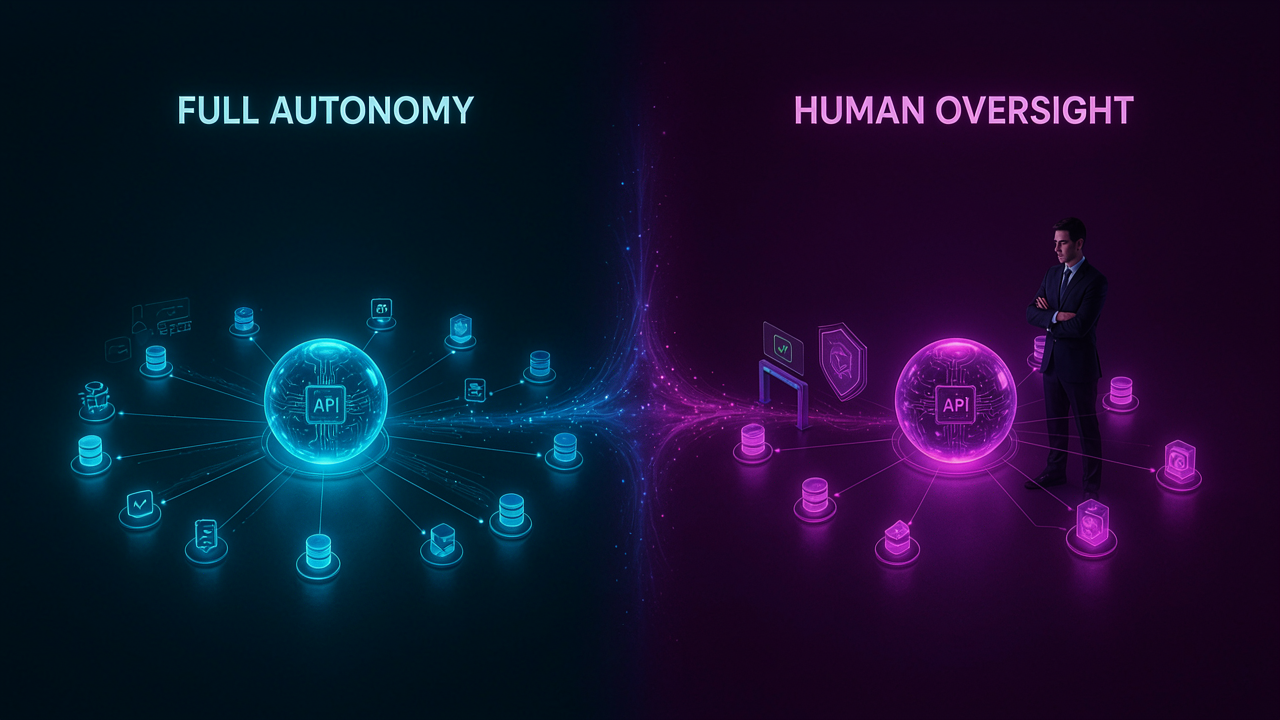
AI agents are becoming capable of handling increasingly complex tasks with limited human intervention. They can analyze information, make decisions, interact with software systems, and execute multi-step workflows.
But giving an AI agent more autonomy also introduces a critical question: when should a human step in?
For organizations deploying autonomous workflows, the goal is not necessarily to remove humans from every process. Instead, humans can be strategically placed at important decision points to review, approve, or override AI actions.
This approach is known as Human-in-the-Loop (HITL).
Let’s break it down clearly.
What Is Human-in-the-Loop?
Human-in-the-Loop is an approach where humans remain involved in an automated or AI-driven workflow at specific stages.
Instead of allowing an agent to make every decision independently, the system identifies actions that require human review.
For example, an AI agent could prepare a customer refund but require a manager to approve the transaction before it is processed.
In this model:
- The AI handles repetitive work.
- The system identifies high-risk decisions.
- A human reviews important actions.
- The workflow continues after approval.
- Humans can reject or modify the proposed action.
The objective is to combine AI efficiency with human judgment.
Why Autonomous Workflows Need Safety Checks
Autonomous agents can process information and execute actions much faster than humans.
However, speed does not guarantee correctness.
An agent could:
- Misinterpret instructions.
- Use incorrect information.
- Select the wrong tool.
- Make an unsuitable recommendation.
- Trigger an unintended action.
- Repeat an error across many transactions.
The consequences become more serious when an agent has access to financial systems, customer records, production environments, or other sensitive resources.
Safety checks provide a controlled point where humans can catch potentially harmful decisions before they become real-world actions.
Where Should Humans Be Involved?
Not every action needs human approval.
Requiring approval for every small task would eliminate much of the benefit of automation.
Instead, organizations can identify high-impact decision points.
Human review may be appropriate when an agent:
- Transfers money.
- Deletes important information.
- Publishes external content.
- Changes production systems.
- Approves a large refund.
- Handles sensitive customer information.
- Makes decisions with significant business consequences.
Low-risk actions, such as organizing information or generating internal drafts, can often remain fully automated.
The Approval Gate
One of the simplest HITL patterns is an approval gate.
The agent completes the preparation work but pauses before executing a sensitive action.
For example:
Request → Agent Analysis → Proposed Action → Human Approval → Execution
Imagine an AI purchasing agent that identifies a required piece of equipment.
The agent could research suppliers, compare prices, and prepare an order.
Before spending company money, the workflow pauses and asks an authorized employee to approve the purchase.
The human does not perform the entire task. They simply approve or reject the critical action.
Human Review as an Exception Mechanism
Another useful approach is to involve humans only when something unusual happens.
Instead of reviewing every transaction, the system can automatically handle normal cases and escalate exceptions.
For example:
- Standard refund → Automatically processed.
- Unusually large refund → Human review.
- Missing customer information → Human review.
- Suspicious transaction → Human review.
This approach allows organizations to maintain high levels of automation without removing human oversight completely.
The system essentially treats human intervention as an exception-handling mechanism.
Risk-Based Autonomy
Different actions should have different levels of autonomy.
A useful framework is to classify actions according to their potential impact.
Low risk:
The agent can act independently.
Medium risk:
The agent can prepare the action but may require additional validation.
High risk:
The agent must obtain explicit human approval.
For example, an AI support agent could automatically categorize incoming tickets but require human approval before issuing a large customer compensation.
This creates a more balanced approach to autonomy.
Designing the Human Review Interface
A human approval step is only useful if the reviewer has enough information to make a decision.
The interface should clearly show:
- What the agent wants to do.
- Why it wants to do it.
- What information it used.
- What the expected outcome is.
- What risks or warnings were detected.
- Which options the human can choose.
For example, instead of showing:
“Approve action?”
A better interface might explain:
“The agent recommends refunding ₹25,000 because the order was duplicated. Review the transaction details before approving.”
Good interfaces reduce the cognitive burden on human reviewers.
Explainability and Decision Context
Human oversight requires more than a simple approve or reject button.
Reviewers need enough context to understand the agent’s recommendation.
This can include:
- Relevant source information.
- Tool results.
- Previous workflow steps.
- Confidence indicators.
- Detected anomalies.
- Policy rules that influenced the decision.
The objective is not necessarily to expose every internal reasoning process of the AI model.
Instead, the system should provide useful decision context that allows a human to evaluate the proposed action.
Human Override and Emergency Controls
A production AI system should also provide mechanisms for stopping or overriding autonomous behavior.
Useful controls can include:
- Pause workflow.
- Reject action.
- Modify proposed action.
- Reassign task to a human.
- Disable specific tools.
- Stop the agent completely.
These controls become particularly important when an agent operates continuously or interacts with external systems.
A human should always have a practical way to intervene when something goes wrong.
Logging and Auditability
Every important intervention should be recorded.
Audit logs can capture:
- What the agent proposed.
- Which tools it used.
- What information influenced the action.
- Who reviewed the action.
- Whether it was approved or rejected.
- What happened afterward.
This creates a traceable history of important decisions.
Auditability is particularly valuable when organizations need to investigate incidents, demonstrate compliance, or understand how an autonomous workflow behaved.
Human-in-the-Loop vs. Human-on-the-Loop
These concepts are related but slightly different.
With Human-in-the-Loop, the human actively participates in the workflow and may need to approve specific actions before they occur.
With Human-on-the-Loop, the AI can operate more independently while humans monitor the system and intervene when necessary.
For example:
Human-in-the-Loop:
Agent prepares a payment → Manager approves → Payment is executed.
Human-on-the-Loop:
Agent processes routine payments → Monitoring system detects anomalies → Human investigates when necessary.
The appropriate model depends on the risk level and desired degree of autonomy.
Documentation Implications
HITL workflows also introduce new documentation requirements.
Traditional documentation may explain what an API does and how developers can call it.
Autonomous workflows need additional information about:
- Which actions require approval.
- Who is authorized to approve them.
- What information reviewers should evaluate.
- What happens when an action is rejected.
- How exceptions are handled.
- How emergency controls work.
Technical writers therefore need to document not only the automated workflow, but also the human intervention points within it.
Building Safety Into the Architecture
Human oversight should not be added as an afterthought.
It should be part of the workflow architecture from the beginning.
A well-designed autonomous workflow can include:
Agent → Risk Assessment → Policy Check → Human Review → Execution → Audit Log
This architecture creates multiple opportunities to detect and prevent unsafe actions.
The goal is not to slow down every workflow. It is to place safeguards exactly where they provide the most value.
Common HITL Mistakes
Organizations can introduce human oversight and still design it poorly.
Common mistakes include:
- Requiring approval for too many actions.
- Providing reviewers with insufficient context.
- Making approval interfaces difficult to understand.
- Giving humans no way to override the agent.
- Failing to record decisions.
- Allowing approval requests to become bottlenecks.
Effective HITL design requires finding the right balance between automation and oversight.
Why Human-in-the-Loop Matters
AI agents will increasingly handle workflows that previously required significant human involvement.
But autonomy should not mean removing humans from the system entirely.
Human oversight provides an important layer of protection when AI decisions have meaningful consequences.
The most effective systems are likely to combine autonomous execution for routine tasks with human intervention for decisions that are uncertain, sensitive, or high impact.
Conclusion
Human-in-the-Loop is not about preventing AI agents from becoming autonomous.
It is about making autonomy controlled and accountable.
Agents can handle repetitive work, analyze information, and execute routine actions, while humans remain responsible for decisions that require judgment, authorization, or oversight.
By combining approval gates, risk-based autonomy, exception handling, human overrides, and audit logs, organizations can build autonomous workflows that are both efficient and safer.
As AI agents become more powerful, the question will not simply be “How much can we automate?”
It will also be “Where should humans remain in control?”
Leave a Reply